Blog

Lines And Ladders Performance Diary 02: Edinburgh, I’m on my way!

In the last few days, my social media feeds seem to have been full of people complaining about the Edinburgh Festival. They have been there and done that. It is not what it was. It is too commercial. It is too big. It has lost whatever heart it once had.

Maybe I’m just sensitive to it, because, this year, I’m going as a performer for the first time. It’s a little disheartening. I won’t be performing as part of the official fringe. I’m on the fringe of the fringe. I’m worried. My piece is a micro-audience performance game. It only needs one audience member and it’s free to participate, but what if I don’t even get that one person? What if they don’t turn up? What if they turn up, but don’t want to sign the forms that are necessary because this isn’t just performance, it’s performance research?

This is a big thing for me. This is my own work. It means a lot to me that it works out.

And that’s exciting.

When I let go of that anxiety, I am amazed that I am doing this. The me of 10 years ago wouldn’t believe it. She thought she had missed this opportunity. To take my work to Edinburgh for the festival season is taking all the nerve I have. So I am going to enjoy it. I am going to ignore the negativity and embrace my own excitement.

At the end of nearly every working day, when I am struggling for inspiration I turn to The Good Lovelies 2015 album Burn The Plan. I remember the story that they tell at gigs about the decision that they made to quit their day jobs and put all their efforts into their music. They are incredibly talented singers, songwriters and musicians, but it still gives me a boost whenever I listen and remember that I had a plan and I started again too.

So whatever happens in Edinburgh – and I will publish this before I go so that I can’t deny this feeling later – I am going to remember that this is part of burning the plan. That when I got stuck, I tried something new. Lines And Ladders is all about a different way of doing family history and it’s a new direction for me. Maybe in a week I’ll feel jaded, but I’m going to enjoy it for as long as I can!

Thank you to friends and family for encouraging me and to the volunteers at The Forest Café for hosting the piece. I promise to make the most of this opportunity. If you want to play Lines And Ladders, with someone still brimming with enthusiasm, you can book tickets here:

https://www.eventbrite.co.uk/e/lines-and-ladders-tickets-46939183361

And there’s loads of information about the research project here:
https://heardofcats.co.uk/lines-and-ladders/

Lines And Ladders Performance Diary 01: The Grand Plan…

A year ago I came up with a plan. A plan that revealed what my research practice would look like. I would create a 1 hour performance. It would incorporate all the stuff that I had been working on – a slideshow, a pack of cards, poetry, ladders – and some new work filling the gaps.

It would mostly be me talking to the audience and then there would be some sort of installation at the end, which would enable participation. The experience at the end making the sharing of stories possible – after all that’s the title of the thesis: Sharing Stories.

The work was done.

I was still experimenting but I had some substantial pieces, some fragments, and some ideas. All I had to do was thread them together, according to the plan.

This is not what I will be taking to Edinburgh this summer.

That plan is still theoretical. It exists as diagram. It will not be the conclusion of my thesis.

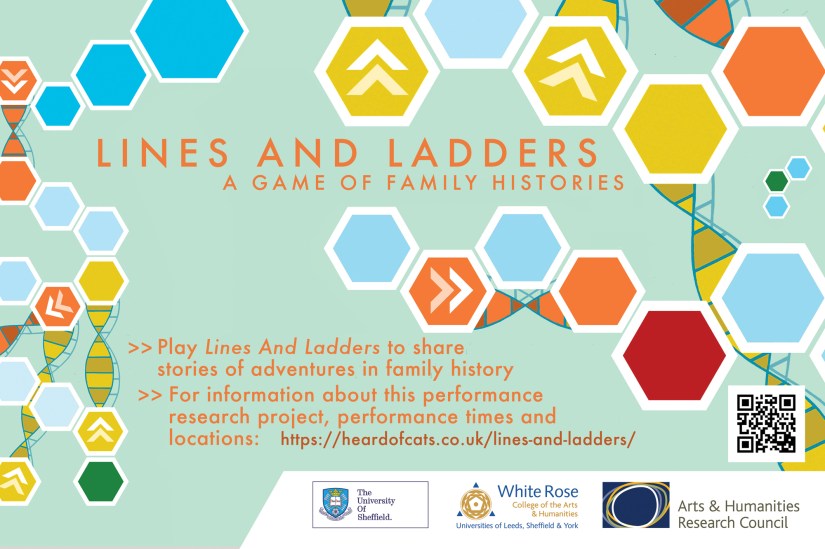
Instead I’ll be playing Lines And Ladders in The Forest Café in Edinburgh throughout August and this will form the final section of my thesis. Lines And Ladders is a board game played by 2-4 people. Using the principle of the game Snakes and Ladders as a starting point, players move across the board following DNA strands up or down. Each of these strands includes a prompt to tell a story: a story of adventures in family history research, of discoveries made or of the blocks encountered.

This game is a long way from the solo performance of the plan and yet it has come directly from it. As I struggled to piece the slices of movement, chunks of text and bits of games into a coherent whole, I realised that I needed to start again.

It was around this time that I struck on the notion of play as method. I realised that the fragments that I had were whole as performance experiments – as play. They form the earlier chapters of my thesis, but the final section needed something that could encompass the breadth of the research question whilst enabling that sharing that is so key to the project. This needed to be something less specifically concerned with my own family stories, but that could provide participants with the space and confidence to share their stories.

I experimented with packs of cards. These could present my family history to an audience. I could talk to the audience about their connections to the photographs, but ultimately it was my family history that was central.

I was thinking about Kim’s game  – the memory game where you have a tray of items, remove one and the players have to guess what is gone. This could be used within performance as an analogy for forgotten stories. This could be presented within the solo performance, because I was still stuck with this idea. The solo performance concluding with audience participation.

I showed my plan to Carran Waterfield on one of the workshops that she has run, which have been so important in the development of this practice. She commented that it looked like Snakes and Ladders… and the route of the work took a new direction.

LAL_Flyer_Jul18

The Image Speaks

Since 2014, the Arts & Humanities Faculty at the University of Sheffield has run a project called The Image Speaks. The aim of the project is to create a photograph that speaks of our individual research projects. This year it was my turn to take part…

When I started the project, I thought that it would be fairly straightforward for me. After all, photographs are central to my investigation. In my first year of research, I spent quite a lot of time ruminating on the history of the photograph, on the distinct processes that produce images of varying colour intensity and the processes of deterioration. The family album is at the core of many family stories – even when it is absent.

However, I struggled to settle on a single idea. My work is full of images. Lots of them. We were asked to bring in an image of our research and I made a collage. Masses of ideas strung together. Fortunately, for this project the responsibility was shared. I attempted to describe my research to the photographer, Andy Brown, and almost immediately he was able to crystallise my rambling thoughts into a single nugget.

The result is the photograph that you can see here:  https://www.sheffield.ac.uk/polopoly_fs/1.779158!/file/TIS_5_Online_Essays.pdf

Mine is number 8 on pages 17-18 – but while you’re there I would recommend that you spend some time looking at the other photographs and reading their essays. Especially that of my fellow theatre scholar Cath Badham, which reflects on the making visible of the backstage labour.

My essay explains what Andy and I were trying to show with our photograph – so I won’t say anything more about that in this blog, but please do let me know what you think @heardofcats