Blog

Lines And Ladders Performance Diary 07: Practice Runs

The game is an experiment. Playing the game I will learn what playing the game means. Tickets are free. Obviously. This is a research project. I can’t charge you to take part. Before the game starts I have a spiel that I have to deliver to ensure that the audience can give their informed consent to participate. I am still working on the best way to deliver this – the content is set. This is the first thing that audiences experience and it should engage them in the game, but also impress the legal and ethical gravitas of what the game is about. This isn’t just a game or a performance, this is performance research and it is important that participants understand this.

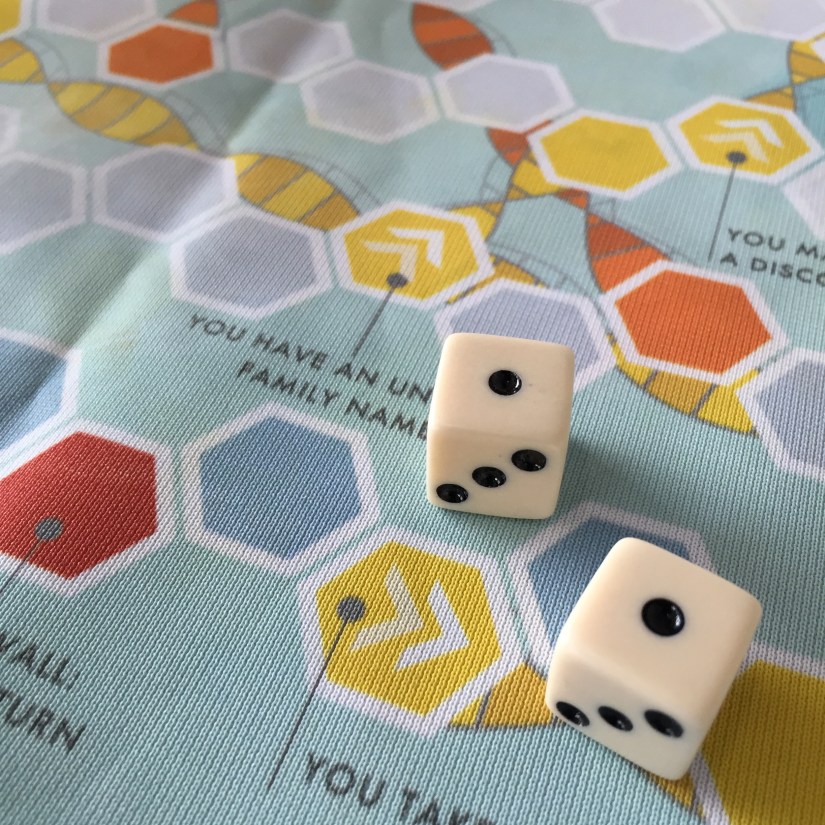
The first trials of the game were played on a board that I had made. A basic grid printed onto A4 and then A3 paper with hand drawn snakes and ladders. This version enabled me to establish that the game could work. And that there was reasonable challenge, though maybe a little more risk was needed. It showed that the board game could create a intimate space for sharing stories. I played a long, unfinished version of the game with Carran Waterfield and saw the potential of the game when played with someone I knew had researched their family history. This also revealed just how long a game might take when there are lots of stories to tell.

Playing with others highlighted that the introduction to the game needed to be clear, that the audience needed to understand what was expected of them and that the storytelling needed to be shared. I needed to lead by example, but give the participant room to bring their stories to the game.

As the game design neared completion, I met with a friend in a café in Sheffield to play the game. This friend, Moe Shoji, as one of the co-producers of Wrought Festival offered valuable feedback on the performance as a micro-audience performance.

Again with someone that I know well the game was a success, but I wondered how well this will translate when played with audience members that I meet for the first time when they attend the show?

We played for more than an hour, discussing Moe’s family history and my own. Although Moe had not done much detailed, academic research into her family history, the game broadened her understanding of what this might mean. About where family history might start. Moe talked about letters that her father had sent to her mother and the insight that this gave her into their relationship. These letters, so personal, become precious documents to those of us seeking to understand our own stories.

I have recently re-read Margaret Forster’s memoir Hidden Lives, as I mentioned in the blog post ‘Privacy Matters’. In Hidden Lives, Forster attempts to write the lives of her mother and grandmother, but finds those gaps and unknowns that plague family historians even when the lives are recent. Forster feels saddened as she acknowledges her failure to account for her grandmother’s first 23 years. She values the importance of knowing what has gone before, stating ‘We are our past, especially our family past, a truism if ever there was one’.

I’m not sure that our character is directly formed by our family past, though I look forward to discussing this idea with players of Lines And Ladders. I do think that learning about our parents’ lives can be enlightening and maybe playing the game might help people to look for those stories.
IMG_1350


Lines And Ladders Performance Diary 06: The Laboratory

The laboratory.

Waves crashing. Ripping plastic.
Noise.
This is why I am here.
Shapes forming.
An ocean rustles into being.

This is why I am here.

 I have been fortunate throughout this process to work with Carran Waterfield. My first experience of her work was as an audience member witnessing The House. Twice. It is a significant work, devised and performed by Carran, which makes use of her own family history to explore wider societal concerns. Since then I have interviewed Carran and attended a series of performance making workshops that she has run in Cumbria, York and Salford.

There is always something of a homecoming at Heron Corn Mill in Cumbria, where this cycle of courses started. The space is offered for reflection and exploration. Nearly an hour spent discussing our work in a way that would not make sense or be helpful anywhere else.

Carran leads a warm up to start the day’s training, though the term ‘warm up’ feels inadequate. These exercises are so important. They help me to find the space to make my work. To listen to myself. They become part of my process when I work on my own.

I wrote the verse that starts this blog in the barn at Heron Corn Mill. I was writing on an ancient laptop – no internet – no temptation to drift. And yet I do. I am in the room and become conscious of what is happening around me. Four of us were present. Four who attended the first course, here again after nearly two years. Luke Crookes is experimenting with his bassoon and recordings of the sea. Another participant is creating waves with plastic and fabric. Carran is watching. In this place we are all making. In this place there is security to experiment.

My ideas have wandered in this place and have been influenced by conversations, by others’ work, by a metal staircase and by being given the time, space and structure to play.

The game that I have made is an attempt to explore family histories, but there is another story here. This working genealogy is important. The questioning, the listening, the activities all form part of the heritage of the work that is created.

I was working in a dark corner of the Mill when Carran made her observation that my plan looked like Snakes and Ladders. It was October. I was cold. I was frustrated. There was so much to include. So many issues to address. So much material to develop. Carran’s statement was a prompt from a place of understanding. A recognition of the need for direction. I toyed with the idea of making it into a board game as a distraction, but Lines And Ladders became a way of including almost everything, if not every time.

IMG_20160927_122318523


Lines And Ladders Performance Diary 05: Privacy Matters

Margaret Forster offers us the story of her own life until the death of her mother in Hidden Lives. She comments that it is necessary to know where she has come from to understand who she is now. Forster has been frustrated because she has struggled to find detail about her grandmother’s life before the age of 23 and states that she finds ‘women like Margaret Ann Jordan [her grandmother] virtually incomprehensible in their passion for privacy and secrecy’.

Yet for all Forster’s willingness to share her life with us through her written pages, she remained a private person. When Hidden Lives was published, I worked in a bookshop in Carlisle and I remember Forster coming in to sign books in the back. This contradiction – the willingness to share in a given framework, but the importance of being able to choose your own terms is one that I sympathize with and is at the core of my research.

The new General Data Protection Regulation (GDPR) includes a right to be forgotten, but no right to be remembered. I have argued throughout my research project, that the participants should be able to choose if they wish to be named. Players of Lines And Ladders are invited at the start to choose whether they want to be anonymous. I think it is vital that the decision is theirs, not mine and not the institution’s. These are family stories, some people choose to tell them as a part of the performance game, but would prefer not to have the stories attached to their name later. For others it is important that when their family stories are retold that they are acknowledged. So far, just over 80% have chosen to be named.

Family historians are often quite keen on sharing. Shared knowledge can lead to the breaking down of brick walls. DNA samples are only useful when compared with those of others. Facebook family history groups can provide connections and some online databases enable users to share family trees, which can be copied and pasted into your own tree.

But there is also considerable anxiety about this sharing. Many of the conversations that I have had playing Lines And Ladders concerns the potential misuse of DNA data. And the copying of others research without checking can lead to inaccuracies and misunderstandings.  

It is interesting to see how keen people are to share their stories within the framework of the game. Whose stories are shared? How much recent history is discussed? This is a public sharing, but is there less to be gained than from the other forms of sharing, such as writing or recording, which can be more easily distributed afterwards? Or is, as I hope it will be, the act of sharing enough of an adventure?

Reference: Forster, Margaret, Hidden Lives: A Family Memoir (London: Penguin, 1996)


Lines And Ladders Performance Diary 04: Twisted Ladders

Staircases have been a recurring image in this research. A staircase at my great grandmothers is one of my earliest memories and this features significantly in one performance text. At Heron Corn Mill, I played with the idea of noise made with the metal staircase, rather than the human voice. The photograph that Andy Brown created for The Image Speaks shows me descending a staircase in the university, my face masked by that of my great-aunt Connie. The staircase can be the site of the grand, verbose entrance or the swift, whispered exit.

I experimented with a step ladder, which is much easier to transport than a staircase and much more flexible for performance. I made it into a barrier defending the family historian from snobbish critique, I climbed it to recover lost memories and hid underneath it to discover forgotten histories. The climbing of the staircase and the stepladders provided easy shorthand for notions of descent and ancestral lines.

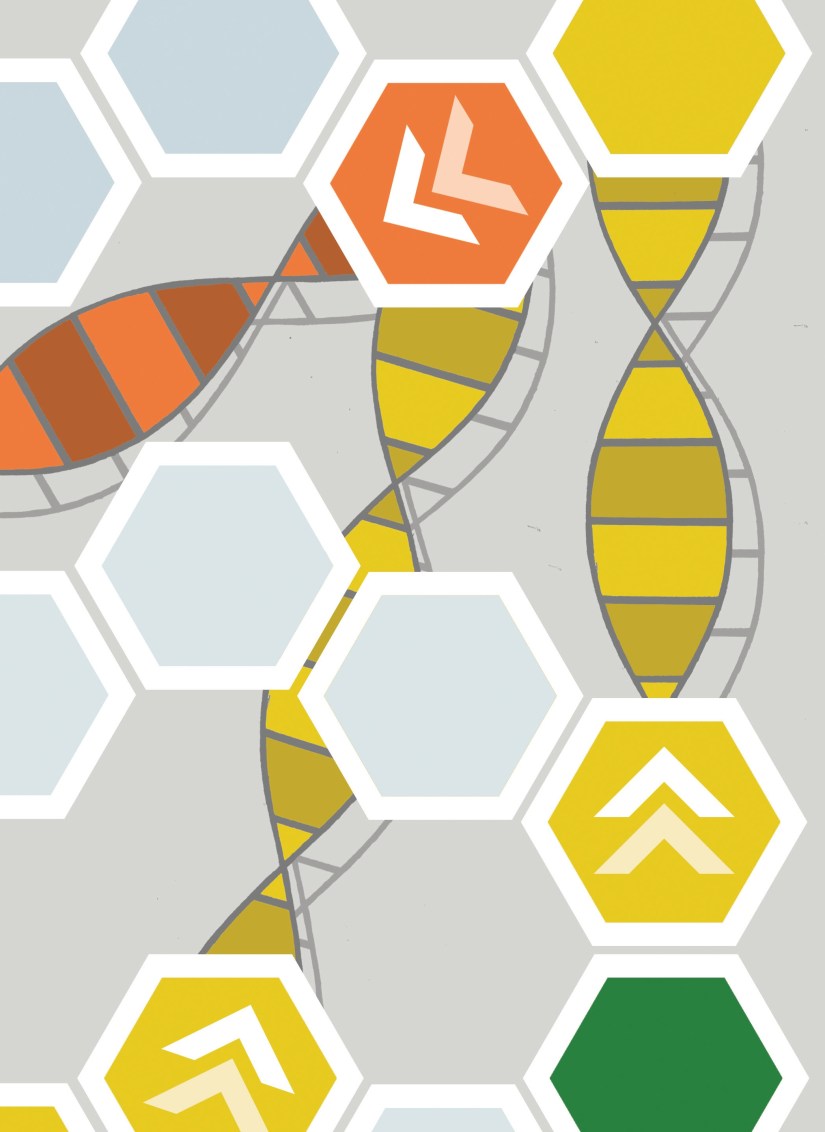
And of course there is the DNA connection. The double helix structure of DNA is a twisted ladder with steps made of base pairs of chemicals.

In some senses DNA is what family history is all about. When we trace our family lines, we are we are tracing the descent of genes. When I share that picture of my great-aunt and people comment how much alike we are – they are seeing the sharing of a genetic heritage.

In recent years DNA testing has become more significant tool in the genealogist’s kitbag. It has become increasingly affordable and, as more people take DNA tests, the databases grow, meaning what the DNA test reveals becomes more informative. Yet, DNA offers a very narrow definition of the family. Step parents and partners with whom we do not share DNA may be significant in our family histories.

The testing of DNA can be controversial. This week as I have been playing the game it is an issue that has arisen repeatedly and so far no one who has played the game has taken a DNA test.

Some of the issues that have been discussed are concerns about data sharing. To be useful in tracing family histories, DNA needs to be shared and there have been cases where DNA results have been used for purposes other than those originally intended. For example, in the US, police have accessed these growing databases to identify suspects. DNA results have been known to reveal family secrets and whilst this may be exciting, it may be distressing. Consider those anonymous sperm donors, whose identity is now revealed.

DNA tests can disappoint those seeking to look backwards. They will reveal more about living cousins than historic lines, as our ancestors weren’t much in the business of getting their DNA tested. Although, this can still prove helpful, as people can seek out their common ancestor and so break down brick walls.

In addition, DNA test results may vary depending which company is used. Each company that offers these tests has their own database from which the genealogical test result is generated. The breadth of material available to those analysing the sample may affect the outcome.

When adapting the game of Snakes and Ladders to explore genealogical stories, DNA presents a useful image. Those twisted ladders may throw up stories that we don’t expect, they may give others more access to our personal data than we wish, but they may also provide the links we need to continue our stories.

DNA is not neutral. The science has implications that need to be considered. When we play Lines And Ladders we discuss the importance of being informed.

The name Lines And Ladders is a reference to genealogical lines and the twisted ladder of the DNA strand. In this game both the snakes and the ladders are replaced by the double helix; this knowledge may change the direction of your quest and not always in the way that you expect.

Board Game6xblankflat_Crop3_June18

Lines And Ladders Performance Diary 03: The Genealogy of the Game

Early in this process my husband volunteered to create the visual element of the game for me. Working with my partner suits this project with its focus on family relations. It is his family name that I wear as a researcher.

The offer to design the game is a generous one. Shane is a trained and experienced graphic designer and art teacher. He is busy with his own work and creative projects, including music as well as design projects.

There is a tradition of adapting Snakes and Ladders to fit the designs of the makers and we look to follow in this genealogy. On a trip to Oxford we study a 19th century version in the Ashmolean Museum. We look at the versions reproduced in Andrew Topsfield’s two articles on the game and examine the V&A’s archive online.

Snakes and Ladders is devised as a game of morals and increasing knowledge. In its earliest known forms it provided a spiritual educational tool in India. Boards were hand drawn on fabric and could be adapted according to local interests. These boards were fragile and the earliest versions seen by Topsfield are from the 19th century, however he conjectures that it based on Buddhist games from the 12th century.

In the game players traverse the board to spiritual enlightenment; the snakes that they encounter are moral shortcomings. When this game is adapted by European and American game manufacturers at the turn of the twentieth century, this moral game play is part of its appeal.

There is so much more to be said about this game’s heritage and I hope to expand on this in a future blog, but for now I wish to focus on how Lines And Ladders developed.

There is no skill in Snakes and Ladders. The winner is determined by the chance of the dice rolls, cowrie shell throws or whatever device is used to randomly allocate forward movement.

For my game, I am keen to embrace this element of chance. This emphasizes the notion that any family history could belong to anyone else. We do not choose our genealogy, but are born into it. However, I am not so happy about the snakes with their moral role. The image of the evil snake carries so much symbolic baggage that it casts a long shadow.

I struggle to find an alternative. The American version Chutes and Ladders has a children’s slide instead of snakes; this seems much more joyful than the threatening snake. However, despite this element of fun, it is difficult to connect to the genealogical focus of the game. I become intrigued by some versions mentioned in Topsfield’s articles, which include no ladders. Instead snakes are colour coded and players can climb using snakes, as well as descend via them.  

As I vacillate between different options, 2018 marches on. The time that Shane has to develop the game before it must be sent to print ready for the August performances grows ever shorter. Finally, I share two examples with Shane from the V&A archive, both are highly illustrative. The detail on each square dictates the direction of play. This style is now too complex in the time that is left, but this idea that the same structure can point in either direction is something that might work…

To read more about the history of Snakes and Ladders:

Topsfield, Andrew, ‘The Indian Game of Snakes and Ladders’, Artibus Asiae, 46:3 (1985) 203-26

Topsfield, Andrew, ‘Snakes and Ladders in India: Some further discoveries’, Artibus Asiae, 66:1 (2006) 143-79  

VAM_Gujarat_SL_Aug18
Gyanbazi © Victoria and Albert Museum, London.

For more information on the game pictured here visit:

https://collections.vam.ac.uk/item/O26345/snakes-and-ladders-board-game/